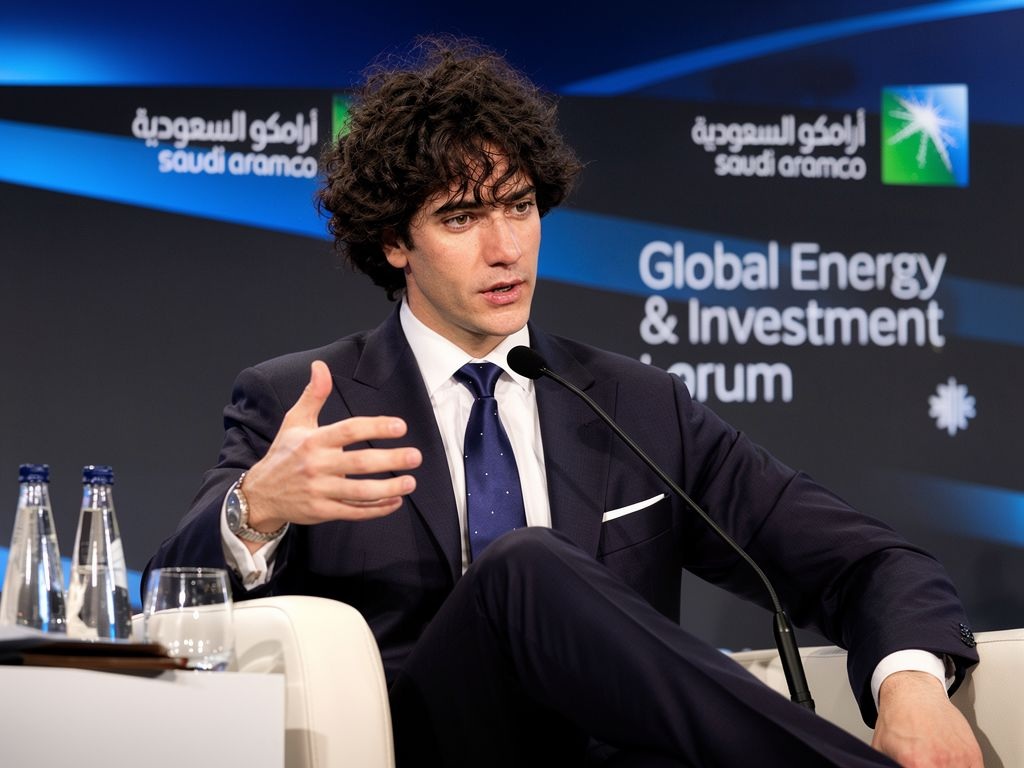
There are diplomatic summits, historic summits, and then there are meetings at which three men with extraordinarily different ideas about the international order sit around the same table and attempt to look agreeable for the cameras.
Donald Trump, Xi Jinping and Vladimir Putin are due to meet in Shenzhen on 19 November, on the sidelines of the APEC summit. It is expected to be their first formal trilateral gathering. The official language is suitably grand: Beijing speaks of world peace and strategic stability; Washington has signalled an interest in nuclear arms reduction and Iran; and Moscow gets the diplomatic theatre it prizes — a seat alongside Washington and Beijing.
No detailed joint agenda has been published, and expectations of a major breakthrough should be treated cautiously. But one subject will be lurking behind almost every conversation, whether it appears in the final communiqué or not.
Energy.
Politicians can discuss peace, sovereignty and the future of civilisation. The global economy, rather less philosophically, still requires oil, gas, electricity and ships to keep moving.
These three leaders bring very different forms of energy power to Shenzhen. Trump represents a country that is a leading producer and exporter. Xi leads the world's largest crude-oil importer and a manufacturing powerhouse increasingly dominant in clean-energy technologies. Putin presides over vast hydrocarbon resources, but needs dependable markets — and has become more reliant on China since Russia's rupture with much of Europe.
The question is not simply who has the most oil or gas. It is who can produce it, buy it, move it, finance it and keep it flowing when geopolitics becomes disagreeable.
1. Trump: the energy superpower with a political headache
The United States enters the meeting with formidable energy credentials. The US Energy Information Administration's November 2026 outlook forecasts crude production of about 13.9 million barrels per day this year, up from 13.7 million in 2025. It expects US liquefied natural gas exports to average roughly 17 billion cubic feet per day in 2026, rising to 19 billion in 2027.
That is more than an industrial achievement. It is strategic leverage. American LNG can offer European and Asian buyers an alternative to supplies they regard as politically or commercially risky. US oil production also gives Washington greater flexibility than it enjoyed when it was more dependent on imported crude.
But energy abundance is not the same thing as immunity. Oil is priced in a global market. A disruption in the Persian Gulf can raise shipping costs, insurance premiums and product prices even for a country producing millions of barrels a day at home.
The current crisis has made that point rather forcefully. The IEA's November Oil Market Report says global supply rose to 105.4 million barrels per day in October as Gulf exports recovered, but those exports remained around 26 per cent below pre-war levels. The report also notes that freight costs remained exceptionally high and that European diesel prices, despite falling from their October peak, were still close to 77 per cent above pre-war levels.
Trump's challenge is to convert American production into durable diplomatic and commercial influence without allowing an overseas crisis to become an inflation problem at home. It is a neat ambition. The oil market, notoriously, has never been especially obedient.
2. Xi Jinping: the world's most important customer
If Trump arrives with supply, Xi arrives with demand — and with an industrial strategy designed to make China less vulnerable to external shocks.
China imported a record average of 11.6 million barrels of crude oil per day in 2025, according to Chinese customs data cited by the EIA and Columbia University's Center on Global Energy Policy. More than 70 per cent of China's oil consumption is supplied by imports, and the overwhelming majority of those imports arrive by sea.
That creates a strategic exposure. China can build ports, refineries, electric vehicles, batteries, solar panels and high-speed railways. It cannot move the Persian Gulf closer to Guangdong.
The Strait of Hormuz matters because it sits between Gulf producers and the Asian customers that buy much of their output. EIA data show that oil flows through Hormuz fell sharply in the second quarter of 2026, before recovering partially in the third quarter. China felt the consequences: its crude imports averaged just 8.1 million barrels per day in the second quarter, 32 per cent below the previous quarter, according to the EIA.
Beijing's answer is diversification, stockpiling and electrification. It buys from multiple suppliers, builds storage, expands renewables and develops domestic technologies. These are not mutually exclusive policies. They are layers of insurance.
Xi also has an unusually powerful negotiating position: China is a major customer for American, Russian and Middle Eastern energy. It can shop around. In commodity markets, the customer with several suppliers is usually in a more comfortable position than the supplier with one very large customer.
3. Putin: the seller who needs a customer
Russia remains a major hydrocarbon producer, but its energy geography has been transformed by the war in Ukraine and the loss of much of its former European gas market.
The pivot towards Asia is real. China has become central to Russia's strategy for maintaining export volumes and revenue. The existing Power of Siberia pipeline is designed to deliver up to 38 billion cubic metres of gas annually to China.
The bigger prize is Power of Siberia 2: a proposed 2,600-kilometre route from Russia's Yamal gas fields, via Mongolia, with a planned capacity of up to 50 billion cubic metres a year. Yet the commercial terms remain the awkward part. Reporting by the South China Morning Post in September 2026 said negotiations had stalled over a substantial gap between Russian and Chinese price expectations.
This is the heart of the relationship. Moscow wants long-term demand and a premium for strategic partnership. Beijing wants secure supply at a price that reflects its bargaining power and the alternatives available to it.
A pipeline can be announced, photographed and given an impressive name. It still requires a price, a contract, financing and construction. In the energy business, sentiment is welcome; bankability is better.
The imbalance does not make the Sino-Russian relationship unimportant. It makes it asymmetrical. Russia has resources China wants. China has a market Russia increasingly needs.
4. The absent participant: Iran and the Strait of Hormuz
Iran will not have a chair at the trilateral table, but it will be present in the calculations of all three leaders.
The conflict involving Iran has turned the Strait of Hormuz into the central test of energy security. Before the disruption, roughly one-fifth of global petroleum liquids consumption moved through the strait. It is also a critical route for Qatari LNG.
The EIA's November 2026 chokepoint data show Hormuz oil flows at 5.1 million barrels per day in the second quarter, recovering to 9.1 million in the third quarter. That is a substantial improvement, but still far below the roughly 21 million barrels per day recorded in 2025.
This is not merely an oil-price story. It is a shipping, insurance, refining and product-availability story. Tankers may be delayed or rerouted; war-risk premiums can rise; refineries may struggle to secure the right crude grades; and shortages of diesel or other products can ripple through transport, agriculture and manufacturing.
For China, the exposure is direct because of its reliance on imported seaborne crude. For the United States, the domestic production cushion is larger, but global prices and maritime disruption still matter. For Russia, high prices may support revenue, although sanctions and constraints on infrastructure and trade complicate the picture.
Trump has indicated that Iran will be among the subjects he wants to raise. Whether Xi can use his relationship with Tehran to influence events is another matter. Commercial influence is not the same as command, particularly in wartime.
5. The real contest is not just about reserves. It is about routes.
Energy geopolitics is often reduced to a league table of reserves and production. That misses the point. Oil and gas must travel, and their movement depends on pipelines, tankers, ports, terminals, insurance, finance and reliable access to sea lanes.
Sanctions have also changed the architecture of trade. Restrictions on Russian energy have redirected cargoes towards Asia and encouraged more complex shipping and trading arrangements. Columbia University's analysis of Chinese crude imports in 2025 estimated that China continued to take substantial volumes of sanctioned crude from Russia, Iran and Venezuela. Such estimates depend on tracking and classification methods, but they underline a wider truth: sanctions can redirect trade rather than simply make it disappear.
For shipowners, charterers, traders and insurers, the distinction is material. A barrel at the loading terminal is not a barrel delivered to the refinery. A cargo delayed by a security incident, trapped by a compliance problem or made uneconomic by insurance costs has a different value from one delivered safely and on schedule.
The shipping industry is not a footnote to energy security. It is one of its operating systems.
6. What each leader wants
Trump wants leverage and a result. American oil and LNG exports give Washington commercial tools, but he also needs stable markets and manageable fuel prices. Iran and nuclear arms reduction are among the issues identified by US officials ahead of the meeting. No one should assume that a trilateral photograph will settle either.
Xi wants stability and strategic room. China needs imported energy, open sea lanes and predictable trade. It wants Russian supplies, but not dependence on a single supplier or an unfavourable price. It also wants to preserve room for commercial engagement with the United States while protecting its technological and industrial ambitions.
Putin wants recognition, revenue and a dependable market. The meeting offers a chance to demonstrate that Russia remains a major diplomatic actor. The energy question is more prosaic: can Moscow turn its political relationship with Beijing into long-term contracts on terms that make economic sense?
A handshake is useful. A bankable 30-year gas contract is rather more useful.
7. Europe's missing chair
Europe is not one of the three powers at this table, but it has plenty at stake. Since Russia's invasion of Ukraine, European governments have reworked their energy supply arrangements, expanded LNG sourcing and sought to reduce strategic dependence on Russian gas.
A disruption in the Persian Gulf still reaches Europe through global prices, freight, insurance and refined-product markets. A closer Russian-Chinese energy relationship also affects the wider balance between Moscow, Beijing and the West.
Europe may not be sitting at the table, but it will be paying attention to the menu.
The risk is that Europe becomes a spectator in conversations that shape its own energy security — while continuing to discover that strategic autonomy is rather more expensive than the phrase suggests.
8. Beyond the photograph
The Shenzhen meeting will be judged by its images, statements and any communiqué that emerges. Its practical significance will be measured elsewhere.
Do shipping flows through Hormuz recover further? Does the Iran crisis move towards de-escalation? Does China offer Russia a commercially meaningful route for more gas, or continue to drive a hard bargain? Can Washington translate its energy production into lasting influence in Asian and European markets?
The wider energy system is changing, but not in the neat sequence suggested by conference slogans. Oil remains essential. LNG is a geopolitical instrument. Renewables and batteries are reshaping electricity and transport. Nuclear power, grids, critical minerals, data centres and industrial supply chains are all part of the same strategic contest.
The old question was: who owns the reserves?
The new one is more demanding: who can produce, refine, finance, transport, insure and deliver energy when the political weather turns unpleasant?
Trump has the wells and LNG terminals. Xi has the industrial machine, the purchasing power and a commanding position in clean-energy manufacturing. Putin has the resources and pipelines, but needs customers willing to sign at the right price.
Each has leverage. None has complete control.
That is the point worth remembering when the cameras flash in Shenzhen. Three men may arrive believing they can shape the world. But somewhere beyond the conference room, a tanker will still be waiting for clearance, a pipeline will be waiting for a contract, and a refinery will be waiting for its next cargo.
In geopolitics, a handshake makes the photograph. In energy, the cargo arriving safely is the result.
Sources and further reading
- Reuters — APEC summit and expected trilateral meeting, 16 November 2026
- International Energy Agency — Oil Market Report, November 2026
- US Energy Information Administration — Short-Term Energy Outlook, November 2026
- US EIA — Strait of Hormuz and other energy chokepoints
- US EIA — China crude oil imports fell in Q2 2026, 31 July 2026
- Columbia University Center on Global Energy Policy — Where China Gets Its Oil
- South China Morning Post — Power of Siberia 2 price negotiations, September 2026
- Reuters — Power of Siberia 2 project and outstanding commercial terms, 20 May 2026
Editorial note: This article is a forward-looking analysis prepared on 17 November 2026, ahead of the scheduled 19 November meeting. It does not report outcomes that have not yet occurred. Figures and forecasts are attributed to the institutions and reporting linked above and may be revised.
The views expressed are the author's own and do not constitute investment advice.