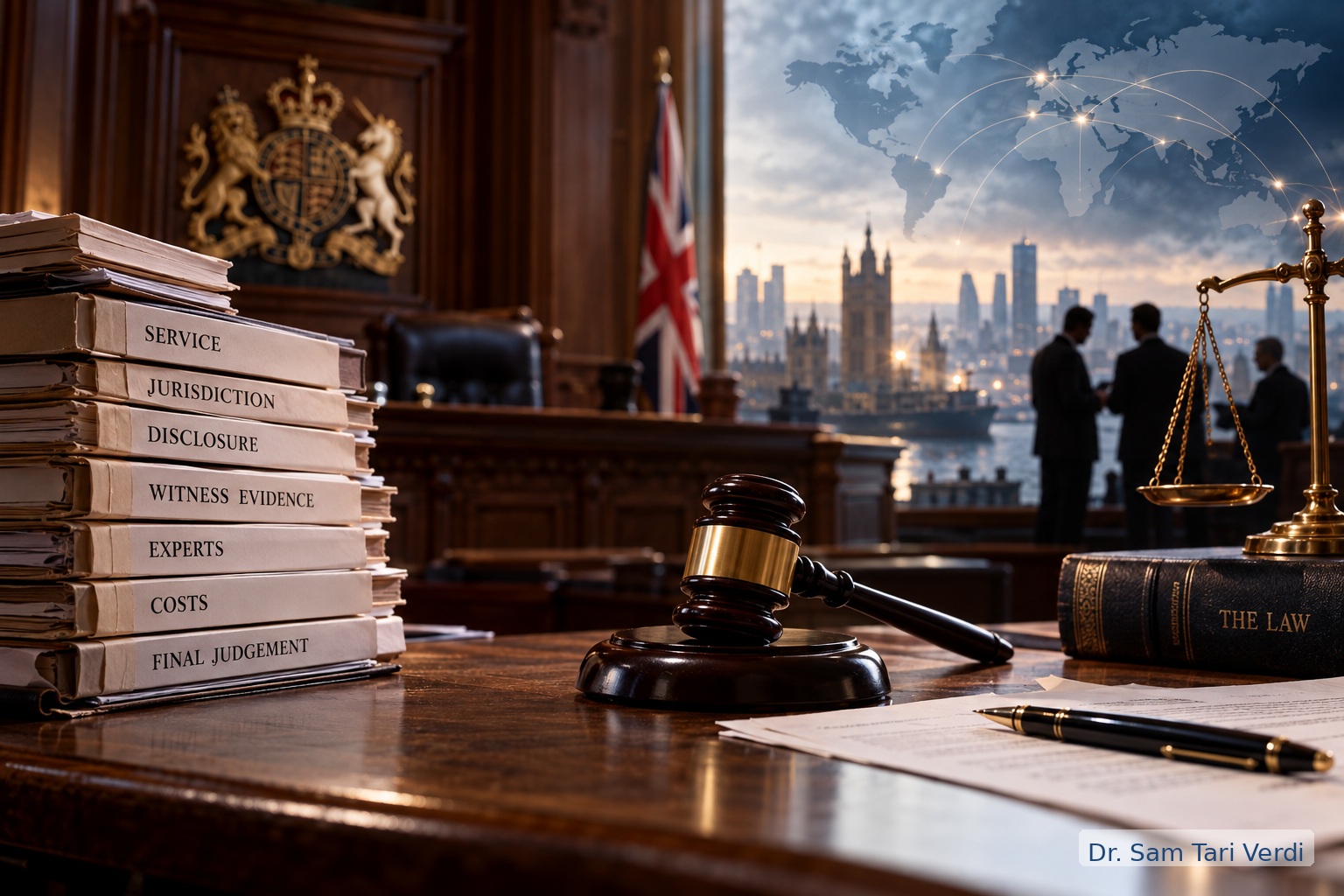
There is a side of litigation that rarely appears in the television version of the courtroom.
It does not involve a dramatic cross-examination. It does not involve a witness suddenly admitting that he has lied. It does not involve a judge dramatically declaring that justice has finally been done.
The real battle often begins months, sometimes years, before the judge reaches the courtroom.
It begins with a letter.
Then a claim.
Then service.
Then a defence.
Then applications.
Then disclosure.
Then witness statements.
Then experts.
Then costs.
Then another application.
And another.
By the time the parties finally arrive at trial, the dispute may bear very little resemblance to the original disagreement.
I have come to believe that one of the least understood aspects of litigation is that the process itself can become a weapon.
That does not mean that solicitors generally behave improperly. They do not. Good solicitors are an essential part of the justice system. They protect their clients, test evidence, challenge weak arguments and help the court reach a proper decision.
But there is a considerable difference between using the rules intelligently to advance a legitimate case and using the machinery of litigation to create pressure, delay, cost or confusion.
The distinction matters. And, in my experience, it is not always as obvious as it should be.
The first move: the letter
Before the court sees anything, there is usually correspondence.
This is where the temperature of a dispute can be established.
A carefully drafted solicitor's letter can make a modest disagreement appear to be a major legal crisis. There may be references to breaches, losses, remedies, costs and potential proceedings.
Sometimes the language is deliberately severe.
There is nothing inherently wrong with being firm. A solicitor is entitled to put a client's position clearly and explain the consequences of failing to resolve a dispute.
But there is a psychological effect.
The recipient may suddenly believe that the other side possesses a mountain of evidence, a watertight legal case and an unlimited appetite for litigation.
The reality may be rather different.
A letter is advocacy. It is not evidence.
Then comes service
Service sounds like administration.
It is not.
The Civil Procedure Rules contain detailed provisions governing service, including service outside England and Wales. Different rules may apply depending upon the country involved, international conventions and the nature of the defendant.
This is particularly interesting when the opposing party is outside the jurisdiction.
Suddenly the litigation is no longer simply between A and B.
It becomes a question of countries.
Where does the defendant live? Where was the contract made? Where was it performed? Which law governs? Where are the assets? Where are the witnesses? Where are the documents? Which court has jurisdiction? Has the defendant submitted to the jurisdiction? Can proceedings be served abroad? Can an injunction be enforced? Can a foreign judgment be recognised?
Sometimes the parties are simultaneously fighting similar battles in two or three countries.
The original commercial dispute can become almost secondary. The dispute becomes a dispute about where the dispute should be decided.
The jurisdiction game
One of the most interesting tactical areas is jurisdiction.
A defendant can challenge the jurisdiction of the English court or argue that the court should not exercise jurisdiction which it otherwise has. That is a perfectly legitimate part of the system.
But in a sophisticated international dispute, jurisdiction can become a battlefield in its own right.
A party may say: “This belongs in London.” The other says: “No. It belongs somewhere else.” The first says: “The contract is governed by English law.” The second says: “But the relevant events happened elsewhere.”
Then comes another application. Then another.
Meanwhile the underlying commercial dispute remains unresolved.
This is where international litigation can become extraordinarily expensive.
The parties are no longer fighting only over who is right. They are fighting over which court gets to decide who is right.
When the opponent is not really just a commercial opponent
In international business, one occasionally encounters disputes in which the other side does not appear to be acting simply as an ordinary commercial entity pursuing an ordinary commercial interest.
There may be a government connection. A state-owned enterprise. A sovereign wealth vehicle. A politically connected individual. A government department. A state-linked financier. Or an entity which, while legally separate from a government, appears to have relationships extending well beyond an ordinary commercial transaction.
One has to be extremely careful here.
A state-owned company is not automatically the same thing as a state. A politically connected businessman is not automatically an agent of a government. And suspicion is not evidence.
But when genuine state interests intersect with commercial litigation, the dynamics can become very different.
The State Immunity Act 1978 creates a general framework for foreign state immunity, while also containing important exceptions, including for commercial transactions. It also distinguishes a foreign state from a separate legal entity capable of suing and being sued.
That distinction can become critical.
Because suddenly the litigation may involve not only commercial law but also sovereign immunity, jurisdiction, enforcement and international relations.
The state proxy problem
There is another situation which deserves discussion.
What happens when a commercial dispute involves an entity that appears, on the evidence, to be acting as a proxy for a wider state interest?
That is a much more serious proposition than saying that somebody is politically connected.
If such a relationship exists, the commercial dispute may have another dimension.
The litigation may still formally be a dispute between Company A and Company B. But the commercial interests behind Company B may be considerably wider.
The question then becomes whether the court is dealing with a genuine private commercial dispute or whether the litigation has become one component of a much larger political or strategic contest.
Again, this should never be alleged without evidence.
But international litigants should not be naïve about the possibility. There are disputes in which commercial assets, energy supplies, shipping routes, sanctions, political influence and international relations overlap.
The English courts are particularly attractive in such disputes because London is a major centre for commercial litigation and arbitration.
That brings enormous advantages. It also means that the English legal system can become an arena for disputes whose real origins lie thousands of miles away.
The foreign court becomes another battlefield
And then there is the multi-jurisdictional fight.
One side starts proceedings in England. The other starts proceedings somewhere else.
Then somebody seeks an injunction. Or challenges jurisdiction. Or argues that proceedings abroad are oppressive.
English procedure contains mechanisms for dealing with foreign proceedings and jurisdictional conflicts, but courts must also take account of comity and the proper role of another country's courts.
This is a fascinating area of litigation because the lawyers are effectively fighting over two courts at once.
One court says it has jurisdiction. Another court may say the same.
The parties can then find themselves spending enormous sums arguing about which court should be allowed to hear the underlying dispute.
The commercial dispute can become almost invisible beneath the procedural battle.
The witness problem
Then we come to something far more serious.
Witness evidence.
A commercial case can stand or fall on the credibility of a witness.
A witness says: “I was there.” Another says: “You were not.” One says: “I heard the conversation.” Another says: “That conversation never happened.” One remembers a meeting in January. Another remembers it in February. One says a promise was made. The other says nothing of the sort was ever said.
This is why fraudulent or deliberately false witness evidence is so dangerous.
And I deliberately use the word fraudulent carefully.
A witness who remembers something incorrectly is not necessarily a fraudulent witness. Human memory is imperfect. A witness can genuinely be mistaken.
But a witness who knowingly gives false evidence is an entirely different matter.
The Civil Procedure Rules provide that a witness statement is evidence and that contempt proceedings may be brought where a person makes or causes to be made a false statement in a document verified by a statement of truth without an honest belief in its truth.
That is not a game.
When a document suddenly appears
I have experienced something in litigation which, even now, I find difficult to reconcile with ordinary common sense.
In one of my own cases, a partner in a kebab shop — a person connected to the underlying commercial dispute — suddenly produced a document which was said to be important to the case.
His explanation was extraordinary.
He said, in substance, that the document had been sitting in a cupboard for a couple of years and that he had only just found it.
I remember thinking at the time that this was one of those moments when litigation ceases to resemble ordinary life.
If an important commercial document genuinely exists, one naturally asks some fairly simple questions.
Why was it kept? Where exactly was it kept? Who put it there? Why did nobody know about it? Why was it not produced earlier? Who created it? When was it created? Was there an electronic version? Was it referred to in any email? Was it mentioned to anyone at the time?
And, perhaps most importantly:
These are not complicated questions. They are the questions that any businessman would instinctively ask.
Yet litigation does not always operate according to the instincts of a businessman.
The document was produced, the explanation was given, and the court accepted the evidence.
I found that profoundly troubling.
I am deliberately not saying here that the witness was lying as a matter of established fact. That is a matter for evidence and, ultimately, the court. What I can say is that I regarded the explanation as extraordinary and wholly unconvincing.
What stayed with me was not simply the document. It was the lesson.
A court does not experience the past.
A judge was not standing in that cupboard two years earlier. The judge did not see who put the document there. The judge did not see whether it had been sitting there for two years. The court can only work with the evidence that is presented.
And that is precisely why the integrity of evidence is so important.
The cupboard defence
There is almost something wonderfully British about the explanation:
Except that, when the document suddenly becomes central to a multimillion-pound commercial dispute, it stops being amusing.
It becomes evidence.
And evidence has consequences.
A genuine document discovered late may, of course, be perfectly legitimate. People lose papers. Archives are badly maintained. Businesses change hands. Old files are forgotten.
I accept that.
But when an important document appears unexpectedly, the correct response should not be automatic acceptance or automatic disbelief.
It should be scrutiny.
That is what courts are for.
And this is where I return to my central concern about litigation.
The machinery of justice depends upon the assumption that the people participating in it are telling the truth as far as they honestly can.
The solicitor must not mislead the court. The witness must give his own evidence honestly. Documents must be disclosed properly. Experts have duties to the court. Advocates must present the evidence fairly.
These are not technicalities.
They are the foundations of the system.
If those foundations are weakened, the courtroom can become a place where the most convincing story wins rather than the most reliable evidence.
That is a very different thing from justice.
The lawyer's dilemma
A solicitor is entitled — indeed obliged — to prepare a client's case properly.
A witness should be questioned. Documents should be reviewed. Potential inconsistencies should be identified. The solicitor should understand what the witness actually knows.
But preparation should not become invention.
The SRA makes clear that solicitors owe duties to the court and the proper administration of justice as well as to their clients.
That distinction is fundamental.
The solicitor represents the client.
The law firm as the shield
There is another phenomenon which I find particularly interesting.
Sometimes the most powerful asset available to a litigant is not the legal argument.
It is the law firm itself.
Put a prestigious name at the bottom of a letter and its psychological effect can be immediate.
The recipient may think: “They must know something I don't.”
The other side may assume: “They must have an extremely strong case.”
A bank may become nervous. A commercial partner may step back. An insurer may become cautious. A counterparty may decide that the dispute is too risky.
The law firm has not necessarily done anything improper. That is important. A reputable law firm may simply be doing its job.
But the existence of the firm can nevertheless become part of the strategic pressure.
And this is where I believe commercial people need to develop a certain discipline.
The name above the letterhead is not evidence.
When legal machinery becomes commercial pressure
This is perhaps the most troubling area.
Imagine a dispute involving a company worth £20 million.
The opposing side knows that defending the case properly may cost £2 million.
Even if the claim itself is uncertain, the defendant has a problem.
Does it spend £2 million defending itself? Does it settle for £1 million simply to make the problem disappear? Does it risk the possibility of a judgment? Does it continue financing the litigation while its underlying business suffers?
This is where litigation can become a war of endurance.
English professional guidance recognises that litigation can be abused by conduct that creates disproportionate cost or delay or uses litigation for purposes unrelated to the proper resolution of a genuine dispute.
That is a very important principle.
It tells us that the legal system itself recognises that its machinery can be misused.
The paper war
There is another tactic which experienced litigants recognise immediately.
Volume.
Letter after letter. Application after application. Thousands of documents. Long witness statements. Multiple experts. Dozens of authorities. Arguments about arguments.
The sheer volume can make a case appear enormous.
But volume is not strength.
Sometimes it is simply volume.
A good judge has to find the important facts among the noise. A good lawyer should help the court do exactly that.
The bad outcome is when the parties become so buried in procedure that the original commercial question almost disappears.
The costs weapon
Perhaps the most powerful weapon in litigation is not the law.
It is cost.
A large corporation may regard £100,000 as an inconvenience. A private individual may regard it as financial ruin. A medium-sized shipping company may find that several hundred thousand pounds of legal costs materially affect its ability to finance vessels, pay suppliers or pursue new business.
This is why costs can change the behaviour of the parties.
A solicitor may be perfectly entitled to warn a client about the costs of losing. But the costs system can also create enormous pressure to settle.
Sometimes that is entirely sensible. Litigation is expensive, uncertain and distracting.
The problem is when the economics of litigation become more important than the merits of the dispute.
Settlement as another battlefield
Settlement is not a sign of weakness. In many cases it is the most rational commercial decision available.
But formal settlement mechanisms can also change the strategic calculations of both sides. Offers may carry significant costs consequences, and the parties must constantly assess not only the merits but also the financial risk of continuing.
The litigation therefore becomes partly a legal contest and partly a financial calculation.
A clever litigator understands both.
The final hearing
Eventually, after months or years, the parties reach the courtroom.
This is the moment many people imagine litigation begins.
In reality, it is often the moment when the previous years of litigation finally produce their result.
The judge has pleadings, documents, witness statements, expert reports, authorities, chronologies, written submissions and a vast amount of material competing for attention.
The advocate's job is therefore not simply to know the law. It is to construct a convincing route through the evidence.
What happened? Why does it matter? Which document proves it? Which witness supports it? What does the other side say? Why is their explanation wrong? And what legal consequence follows?
That is advocacy.
But it is also perception.
The danger is that a beautifully presented argument can sometimes make a weak proposition sound stronger than it really is.
The safeguard is evidence.
And then comes the judgment
The judgment is supposed to bring the theatre to an end.
But even here, the litigation may not be finished.
There can be questions about the precise wording of the order. Interest. Costs. Enforcement. Corrections. Applications. And potentially an appeal.
An appeal is not simply an opportunity to tell the same story again. It is a structured review of a lower court's decision, subject to the rules and the circumstances of the case.
And so the machine can continue.
What I have learnt from watching litigation
The most important lesson I have learnt is that the courtroom is only the visible part of litigation.
The real battle often takes place elsewhere.
In correspondence. In pleadings. In jurisdiction. In disclosure. In witness preparation. In expert evidence. In applications. In costs. In settlement negotiations. In foreign courts.
And sometimes, unfortunately, in the ability of one party to make the other party spend more money than it can afford.
This does not mean that litigation is broken.
It means that litigation is a human system.
And human systems can be manipulated.
That is precisely why rules, judges, professional standards and evidence matter.
When the court becomes a battlefield between states
There is a temptation to write: “States use law firms to manipulate British justice.”
I would not write that.
It is too broad. It is also unnecessary.
The more intelligent proposition is this:
That is a legitimate subject for discussion.
Where a party is genuinely acting as a proxy for another state, the appropriate questions are not conspiratorial ones.
Who is the legal party?
What is its legal status?
Who owns it?
Who controls it?
What documents demonstrate that relationship?
What commercial interest is actually being pursued?
What evidence exists of the alleged state connection?
That is how serious international disputes should be examined.
Not through conspiracy.
The best defence
So what is the answer?
For me, it is remarkably simple.
Keep the documents.
Keep the emails.
Keep the contracts.
Keep the bank records.
Keep the chronology.
Keep the original versions.
Keep contemporaneous correspondence.
Do not exaggerate.
Do not answer every provocation.
Do not allow a solicitor's letter to frighten you into believing that the other side has already won.
And, above all:
A solicitor can construct an argument. A barrister can make that argument sound compelling. A bundle can contain thousands of pages.
But ultimately the judge has to decide the case on the evidence and the law.
Justice or endurance?
There is one final question that I think deserves to be asked.
That is the point at which litigation becomes dangerous.
Not because lawyers are inherently dangerous. They are not.
Good lawyers are essential to the rule of law.
But litigation is a machine.
And like every machine, it can be used well or badly.
The rules are designed to make that machine produce justice at proportionate cost.
The challenge is ensuring that procedure never becomes more important than the dispute it was created to resolve.
Because behind every commercial claim there are usually real people.
Employees. Shareholders. Families. Investors. Shipowners. Banks. Businesses.
And sometimes an entire company whose future depends upon the outcome.
I have seen enough of international business to know that commercial disputes are rarely as simple as they appear on paper.
But I have also learnt something else.
The longest letter is not necessarily the most persuasive.
The largest legal team is not necessarily the best.
The party with the greatest political influence is not necessarily right.
And the party that spends the most money is not necessarily the party that should win.
Eventually, everything comes back to the same place.
The documents.
The evidence.
The law.
And the truth.
That is where litigation should end.
And that, ultimately, is where justice has to begin.