The Intelligent Ocean
Artificial Intelligence, Connected Ports, Autonomous Vessels and the Future Architecture of Global Trade
Abstract
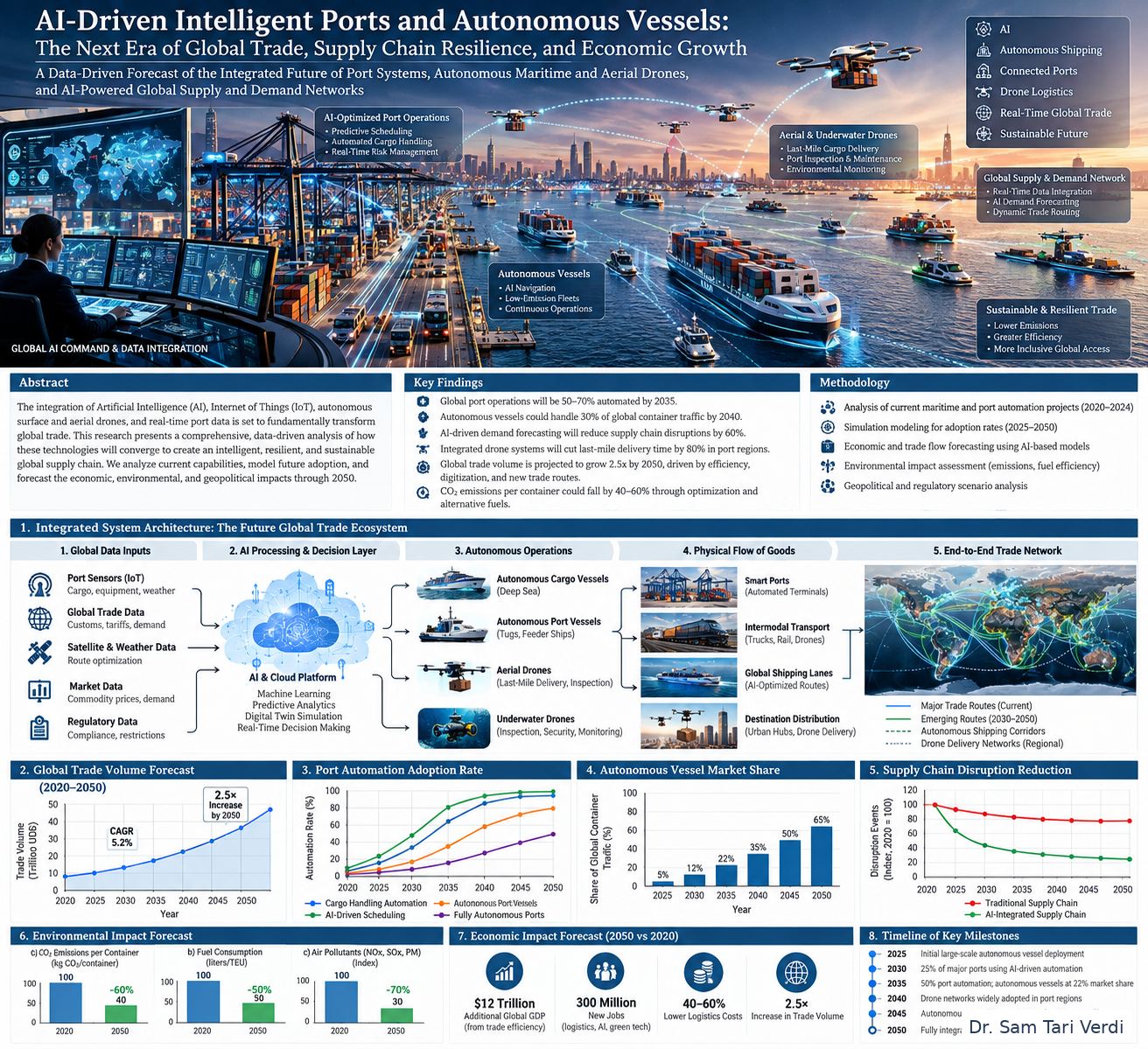
This paper examines how artificial intelligence, connected port data, autonomous and remotely operated vessels, satellite and Internet-of-Things sensing, digital twins and predictive supply-and-demand analytics could alter the architecture of global trade. The argument is deliberately separated into three categories: observed evidence, published external scenarios, and author-developed analytical scenarios. The evidence base includes IMO regulatory developments, UN Trade and Development analysis of maritime digitalisation, World Bank operational port data, and OECD/ITF long-term freight modelling. The paper argues that the decisive transformation is unlikely to be the autonomous ship in isolation. Rather, it will be the integration of the ship, port, cargo, market and inland logistics layers into a continuously updated decision system.
Keywords: artificial intelligence; maritime autonomous surface ships; ports; AIS; digital twins; supply and demand; freight; maritime economics; logistics; global trade.
1. Research question and scope
The central research question is: How could the convergence of AI, real-time maritime data, connected ports and autonomous vessels change the economics and resilience of global trade between 2030 and 2050? The analysis focuses on commercial shipping and logistics rather than attempting to forecast the exact market share of any individual technology. Long-range technology adoption is highly uncertain; consequently, the paper uses scenario ranges rather than presenting speculative point estimates as facts.
2. Evidence base
Maritime transport remains foundational to international commerce: UN Trade and Development states that around 80% of the volume of international trade in goods is carried by sea. UNCTAD also identifies AIS, big-data analytics, AI and advanced communications as technologies with potential to improve routing, maintenance, freight pricing and supply-and-demand forecasting.
The World Bank's Container Port Performance Index provides a particularly useful operational evidence base. Its 2025 assessment covers 403 container ports and draws on more than 175,000 vessel calls and 247 million container moves. The index measures vessel time in port and is designed as a data-driven diagnostic of port efficiency.
The World Bank's 2025 Logistics Performance Indicators similarly moved towards shipment-level operational data, using large-scale tracking information to measure connectivity, speed and reliability rather than relying primarily on perceptions.
3. Long-term freight demand
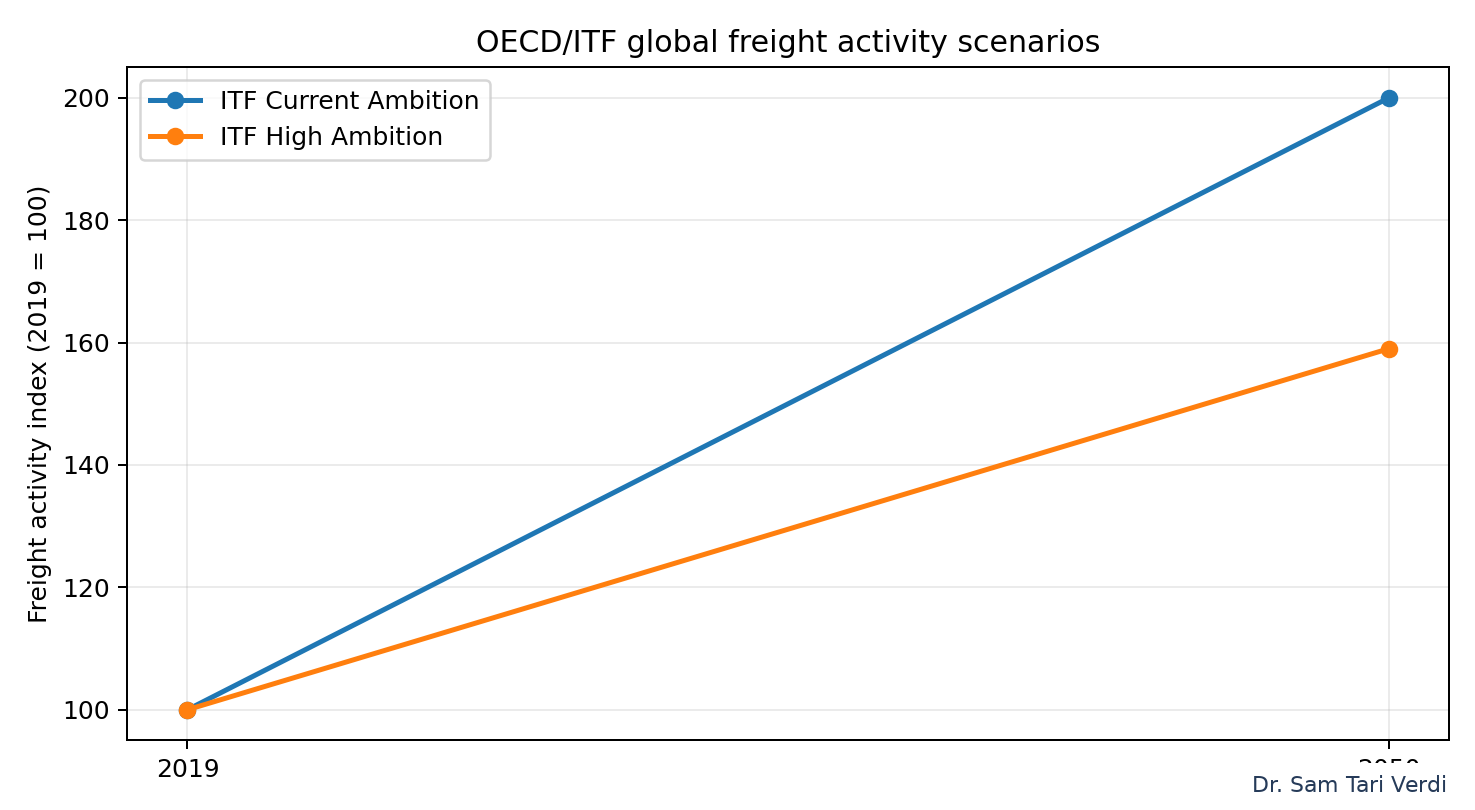
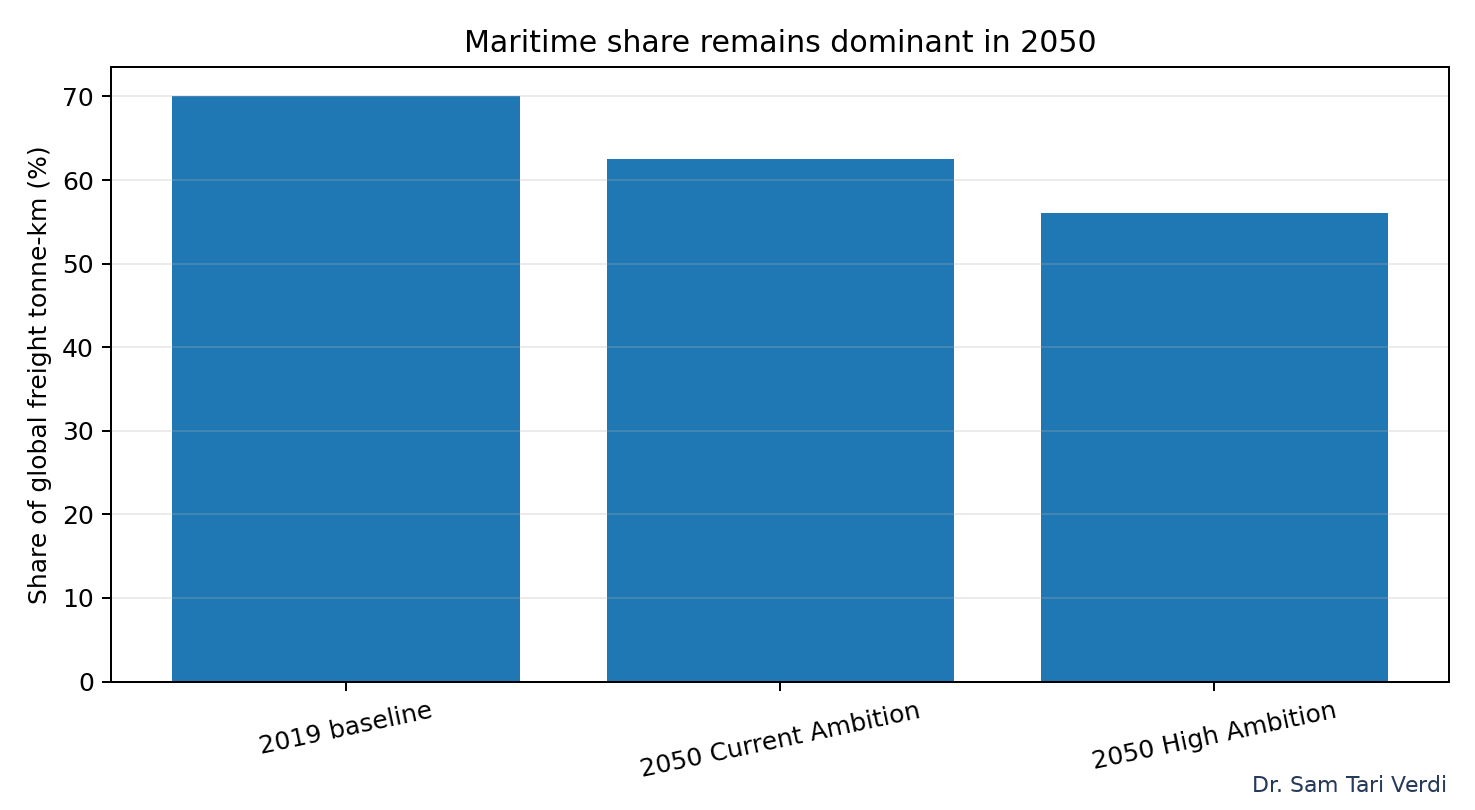
OECD/ITF modelling provides a useful outer boundary for the physical system within which AI will operate. Under its Current Ambition scenario, worldwide freight activity measured in tonne-kilometres nearly doubles between 2019 and 2050. Under the High Ambition scenario, freight demand grows by 59%. The modelling also finds that maritime transport remains the largest mode by tonne-kilometres, although its share falls from 70% in 2019 to 62.5% under Current Ambition and 56% under High Ambition in 2050.
4. Why AI changes the supply function
Traditional shipping supply is usually represented through fleet capacity, vessel availability, speed and utilisation. An AI-enabled system adds an information dimension. Better forecasts of port congestion, cargo availability, weather, maintenance and demand can reduce waiting and repositioning. Consequently, effective transport capacity can rise even without a proportional increase in the physical fleet. This is an economic proposition rather than a claim that AI creates physical tonnage.
UNCTAD has specifically discussed the use of real-time AIS combined with weather, ocean-current and port-status information for dynamic routing, as well as the use of data analytics for freight-price prediction. This supports the hypothesis that information can increasingly become an operational input into freight supply.
5. The connected-port hypothesis
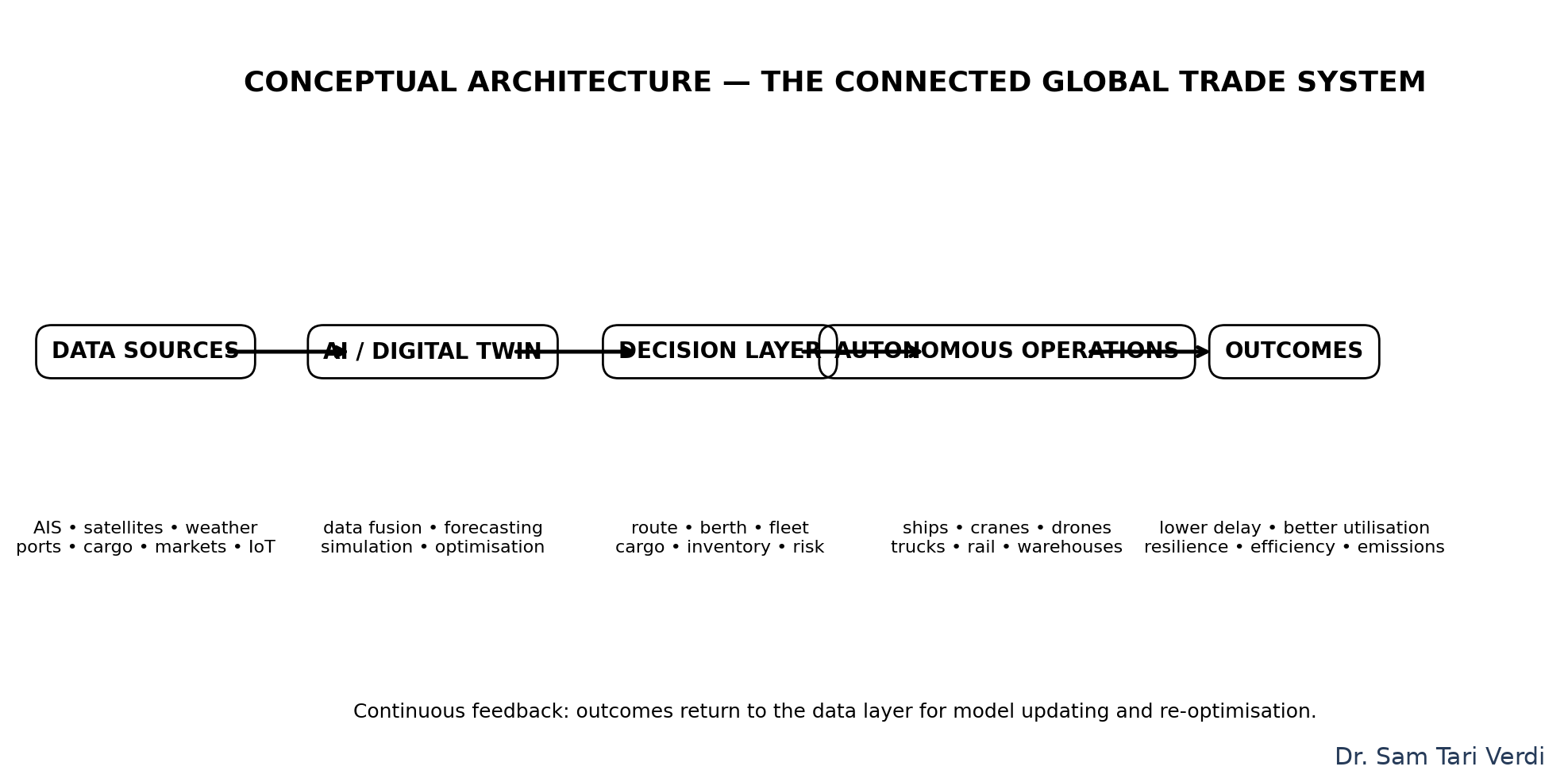
A future intelligent port can be conceptualised as a continuously updated digital twin. Inputs could include vessel positions, berth occupancy, crane status, channel depth, weather, tides, customs status, truck and rail capacity, cargo nominations and downstream demand. AI models can then estimate arrival distributions rather than relying on a single ETA, identify congestion before it occurs, and optimise berth, crane and hinterland resources.
The critical prerequisite is interoperability. The technology stack cannot be intelligent if its underlying data is incomplete, inconsistent or inaccessible. IMO's Maritime Single Window framework is therefore strategically important: it establishes a common direction for electronic information exchange around ship calls.
6. Autonomous vessels and the regulatory pathway
The IMO adopted a non-mandatory Maritime Autonomous Surface Ships (MASS) Code in May 2026, effective from 1 July 2026. The Code establishes a goal-based safety framework for remotely controlled and autonomous commercial ships and explicitly recognises remote operations centres and continued human responsibility. IMO's roadmap anticipates development of a mandatory MASS Code in 2028, expected adoption by 1 July 2030 and entry into force on 1 January 2032.
This regulatory sequence suggests that autonomy is more likely to emerge incrementally than through a single technological discontinuity. A plausible pathway is AI-assisted conventional ships, remote supervision, autonomous short-sea and feeder services, and only later wider deployment of autonomous deep-sea operations.
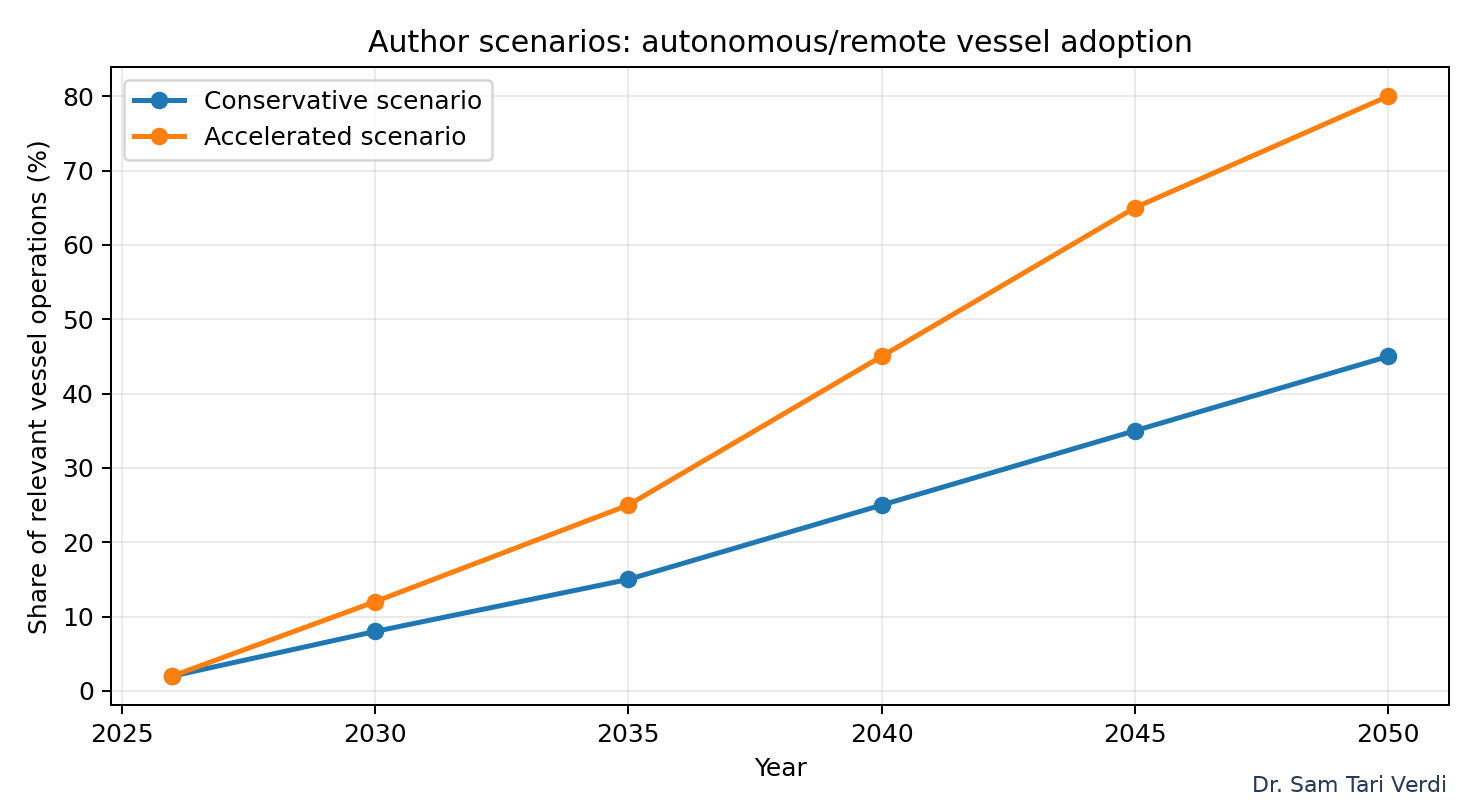
7. Author scenarios for autonomous adoption
The following chart is intentionally not presented as an industry forecast. It is a research scenario showing two possible adoption pathways for autonomous or remotely operated vessel operations. The percentages are analytical assumptions designed to test system consequences and should be replaced by empirical observations as commercial deployment data accumulates.
8. Supply, demand and freight markets
The most consequential development may be the fusion of physical logistics information with commodity and demand information. A system that combines inventories, refinery utilisation, industrial output, commodity prices, vessel availability, port congestion and weather can estimate not only cargo demand but the probability that available cargo will reach a destination within a particular time window. This creates a more complete representation of effective supply.
For tanker, dry-bulk and gas markets, the concept of tonne-miles is particularly important. A geopolitical event can leave physical consumption broadly unchanged while lengthening routes and therefore increasing demand for vessel capacity. AI systems should therefore model both tonnes and distance, alongside port and corridor constraints.
9. Digital twins and predictive logistics
A digital twin of a port is relatively tractable because the physical boundary is clear. A digital twin of global trade is much harder. It would have to represent a network spanning production, shipping, ports, storage, inland transport and consumption. The practical objective should therefore be probabilistic rather than perfectly deterministic: continuously update the likelihood of congestion, shortage, delay and demand change as new observations arrive.
10. Cybersecurity and governance
The more integrated the network becomes, the greater the systemic consequence of cyber failure. A connected port can be more efficient but also more dependent on data availability, identity, authentication and resilient communications. AI governance must therefore include data provenance, model monitoring, cybersecurity, human override, auditability and controls against algorithmic coordination that could undermine competition.
11. Economic implications
The economic effect should be understood primarily through utilisation and variance reduction. Faster turnaround can increase asset productivity. More accurate arrival predictions can reduce inventory buffers. Better maintenance prediction can reduce unplanned downtime. Dynamic routing can reduce fuel use and delay. Better demand forecasting can reduce mismatches between cargo and vessel supply. None of these effects requires a fully autonomous vessel; autonomy amplifies them by enabling machine-to-machine execution.
12. 2030–2050 research agenda
The next phase of research should focus on measurable variables rather than headline claims. Recommended indicators include: vessel waiting time; berth productivity; ETA error; port-call duration; autonomous-operation hours; remote-intervention frequency; fuel consumed per tonne-mile; cargo dwell time; inventory days; freight-rate forecast error; disruption recovery time; and the share of trade flows represented in interoperable digital systems.
A rigorous empirical programme could then compare digitally integrated ports with less integrated control groups, controlling for vessel mix, cargo type, weather, infrastructure and geopolitical disruptions. This would allow the industry to distinguish genuine AI productivity gains from improvements caused by conventional capital investment.
13. Conclusion
The future of global trade is unlikely to be determined by autonomous ships alone. The more consequential development is the emergence of a connected maritime information system in which ships, ports, cargo, markets and inland logistics continuously exchange data and increasingly make coordinated decisions.
The physical ocean will remain. Ships will remain. Ports will remain. Human judgement will remain essential. What changes is the intelligence layer connecting them. If the industry succeeds in building interoperable data standards, resilient communications, trustworthy AI and effective human oversight, global trade could become substantially more predictive, efficient and resilient. The central competitive asset may therefore shift from simply owning transport capacity to understanding the entire network in which that capacity operates.
Selected references
- International Maritime Organization (2026), FAQ – Autonomous shipping / MASS Code.
- UN Trade and Development (2024), Navigating the Future: How AI, big data, and autonomous systems are reshaping maritime transport.
- UN Trade and Development, Review of Maritime Transport, 2025.
- World Bank & S&P Global Market Intelligence (2025), Container Port Performance Index 2025.
- World Bank (2025), Logistics Performance Indicators 2.0.
- OECD/International Transport Forum (2023), ITF Transport Outlook 2023.
Research note: This paper distinguishes observed evidence, published external scenarios and author-developed analytical scenarios. Scenario percentages are illustrative assumptions rather than measured market shares or guaranteed forecasts. The paper is research analysis and commentary, not technical, legal or investment advice.