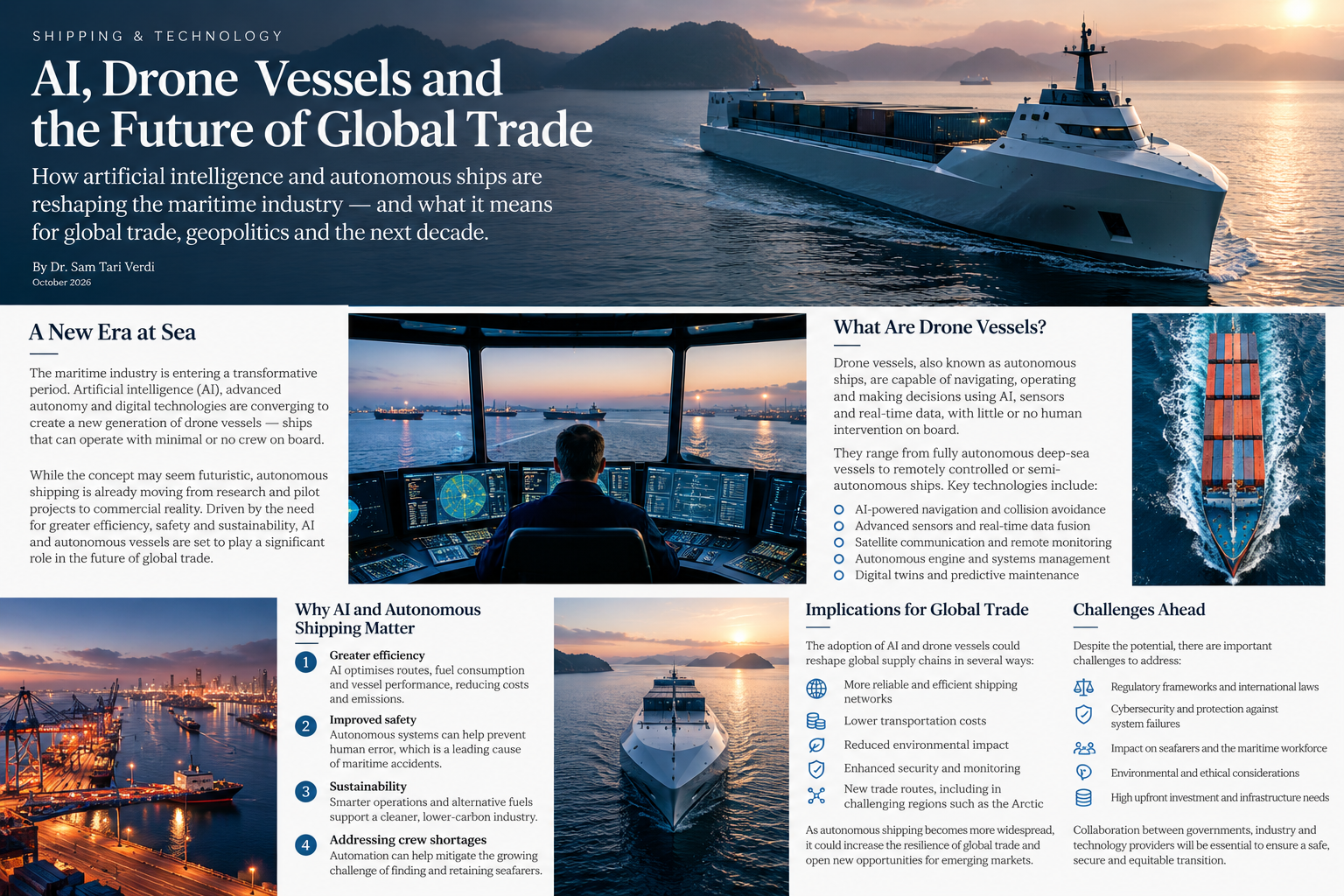
AI, Drone Vessels and the Future of Global Trade
How artificial intelligence and autonomous ships could reshape maritime operations, supply chains and the movement of goods around the world.
For centuries, shipping has connected producers, markets and people across oceans. Its next transformation may come not from a new class of engine or a larger hull, but from the intelligence layered across the vessel, the port and the supply chain. Artificial intelligence (AI), advanced sensors, satellite connectivity and autonomous systems are changing how ships are navigated, maintained and managed.
The phrase “drone vessel” often suggests a completely crewless ship. In practice, the future is likely to be more gradual and varied: vessels with automated functions, ships monitored from shore, and, in selected operations, ships capable of navigating with limited human intervention. The central question is not simply whether ships can sail without crews, but where autonomy creates a safe, reliable and commercially worthwhile advantage.
AI is already changing the business of shipping
AI’s most immediate contribution is not a ship that makes every decision alone. It is the ability to analyse large volumes of information faster and connect decisions that have traditionally been made in separate departments.
- Voyage optimisation: combining weather, currents, traffic, port congestion and fuel data to support route and speed decisions.
- Predictive maintenance: identifying patterns in machinery data that may indicate a developing fault, allowing maintenance to be planned before a breakdown.
- Fleet and cargo visibility: bringing vessel, terminal, cargo and schedule information into a clearer operational picture.
- Safety support: helping crews and shore teams detect anomalies, assess risk and manage complex information.
These applications do not remove the need for experienced mariners. Their value depends on reliable data, transparent system design and people who understand when an algorithm’s recommendation should be questioned.
What do we mean by a drone vessel?
Autonomous shipping is not a single technology or one fixed operating model. A vessel may automate selected functions while retaining a full crew; it may be remotely monitored or controlled from a shore-based centre; or it may perform a defined voyage with a high degree of autonomy. The appropriate level depends on the vessel, route, operating environment and risk.
Short, repeatable routes—such as certain coastal, harbour, ferry, offshore-support or inland-waterway operations—may provide more manageable settings for early deployments than a complex ocean passage. This is a practical pathway, not a guarantee: even a short route can involve dense traffic, changing weather, human activity and demanding port interfaces.
From ship to shore: the rise of remote operations
Remote Operations Centres (ROCs) can allow trained personnel to monitor a vessel, support navigation and intervene when required. They may oversee more than one ship, but the workload cannot be measured simply by counting vessels on a screen. It depends on the complexity of each voyage, alert quality, communications resilience and the ability to respond to emergencies.
Connectivity is therefore a critical part of the system. Ships need secure, dependable links, but they must also be designed to remain safe when communications are delayed or lost. A robust vessel should know its operating limits, detect when conditions exceed them and move into a predefined safe state while appropriate human support is mobilised.
What could this mean for global trade?
If deployed safely and at scale, AI and autonomy could influence trade through several channels. Better planning may reduce avoidable fuel use and schedule disruption. More consistent equipment monitoring may reduce unplanned downtime. Remote support may make some operations possible in locations where recruiting and retaining crews is difficult. Automated inspection and port processes could also improve the flow of information between ships and terminals.
These gains would not be distributed evenly. The economics will vary by vessel type, route length, cargo, insurance terms, connectivity costs, port readiness and the cost of retrofitting existing tonnage. A new autonomous design may make sense for a dedicated service but not for an older vessel operating irregular voyages. The business case must be proven route by route.
For global supply chains, the wider opportunity is integration. A ship that can share trusted arrival estimates and operational data with terminals, cargo owners and logistics providers may help reduce uncertainty across the journey. But digital visibility is only useful when data is accurate, interoperable and protected from misuse.
Regulation is moving from concept to framework
A significant milestone arrived in 2026. The International Maritime Organization adopted its non-mandatory International Code of Safety for Maritime Autonomous Surface Ships (MASS Code) in May, with the Code taking effect on 1 July 2026. It provides a goal-based framework for the safe integration of remotely operated and autonomous cargo ships covered by SOLAS Chapter I. The framework addresses matters including operational modes, navigation, remote operations, safety, security and human oversight. The master retains overall responsibility, even when not physically on board.
The Code is an important step, but it is not the end of the regulatory process. The IMO has set out further work to gather operational experience and develop a future mandatory framework. The transition will also require attention to liability, insurance, port state and flag state responsibilities, collision rules, search and rescue, labour standards and the ship–shore interface.
The challenges that will decide the pace
Technology alone will not determine adoption. Several questions remain central:
- Cybersecurity: connected vessels and shore centres create systems that must be protected against disruption, manipulation and unauthorised access.
- Responsibility: owners, operators, software providers, remote operators and masters need clear roles when a system fails or an incident occurs.
- Human factors: watchkeeping, training, fatigue, situational awareness and the consequences of moving work from ship to shore require careful design.
- Infrastructure: ports, communications providers, regulators and emergency services must be able to interact with different vessel systems.
- Commercial proof: investment must be justified by measurable improvements in safety, reliability, cost or environmental performance—not by novelty alone.
What happens to seafarers?
Autonomy will change maritime work, but it should not be framed as a simple replacement of people by machines. Some tasks may be automated; others may shift to shore-based teams; and new roles will emerge in systems supervision, data interpretation, cyber resilience, maintenance and remote vessel operations. The transition will require training pathways and a serious discussion about career progression, responsibility and the value of practical sea experience.
Human judgement remains essential in abnormal situations. The industry’s challenge is to design systems that support that judgement, rather than create overconfidence or leave people responsible for decisions they cannot meaningfully influence.
A gradual transformation, with global consequences
The most plausible future is a mixed fleet: conventional ships using increasingly sophisticated AI; vessels with selected autonomous functions; remotely supported operations; and, over time, more highly autonomous ships in suitable services. These models will coexist, connected by ports and trade networks that must adapt.
For shipowners, charterers, ports and cargo interests, the strategic task is to separate operational value from technological excitement. Start with a defined problem, establish safety and performance measures, test in a controlled environment and build the necessary skills and governance. For policymakers, the priority is to make innovation compatible with safety, accountability, fair work and open trade.
AI will not make the sea predictable, nor will it remove the complexity of global commerce. But it may give the maritime industry better tools to navigate that complexity. The future of drone vessels will ultimately be judged not by how few people are on board, but by whether shipping becomes safer, more dependable, more sustainable and more useful to the world it serves.
Further reading
- International Maritime Organization, “IMO adopts first global Code for autonomous ships” (22 May 2026).
- International Maritime Organization, Autonomous Shipping (MASS) – FAQ and regulatory roadmap.
- UK Maritime and Coastguard Agency, “Landmark support for shipping innovation with publication of MASS Code” (1 July 2026).
- European Commission, Maritime Autonomous Ships and Shipping.
Editorial note: The image is an AI-generated conceptual illustration, not a photograph of an operating commercial vessel. This article is analysis and commentary, not technical, legal or investment advice.